
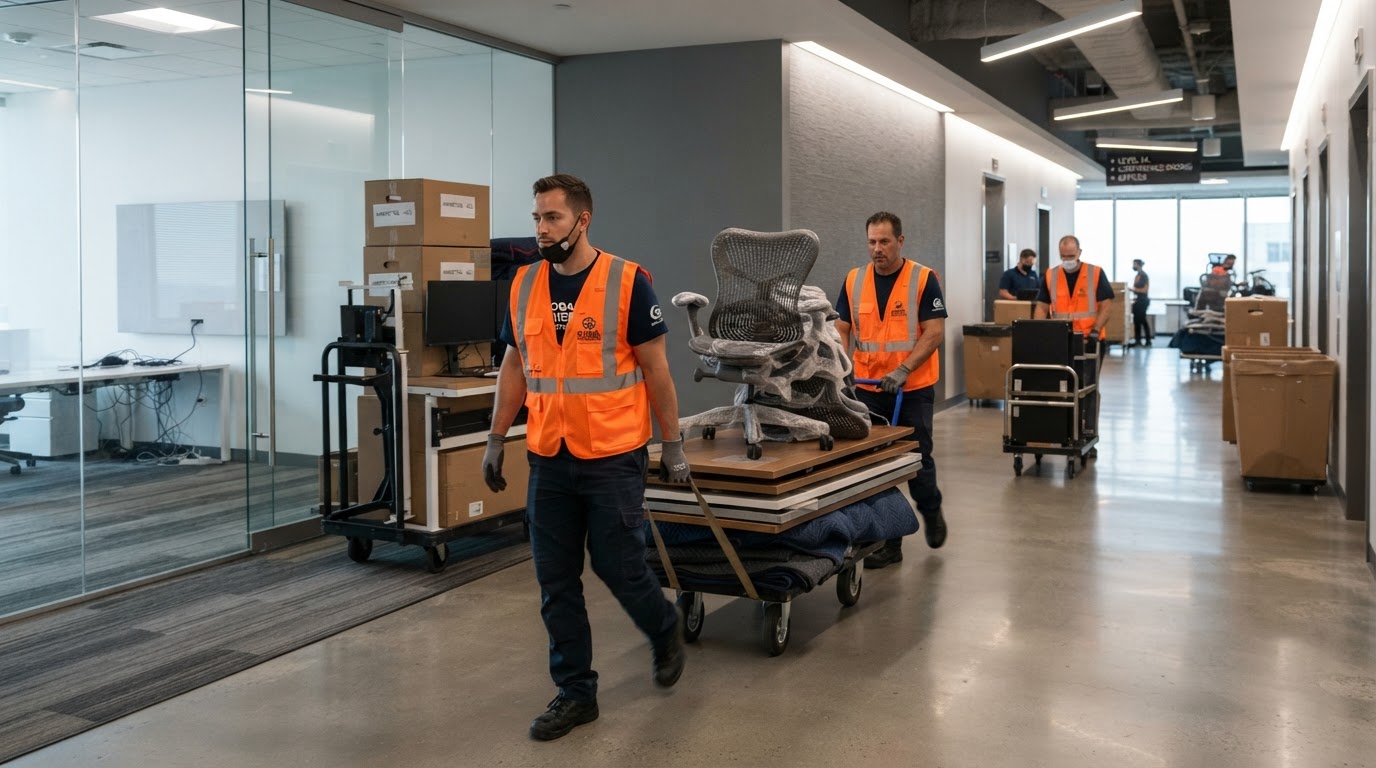

The difference between commercial office movers and residential moving companies is not a matter of scale — it is a matter of specialization. A residential mover who takes an occasional office job is not a commercial mover with a smaller crew; they are a residential mover without the training, equipment, or project management that a corporate relocation requires. Understanding that distinction is the first step in hiring the right partner.
Commercial office movers operate in a different trade. They train crews in modular furniture systems, carry specialized equipment, manage building access and certificates of insurance, and execute moves on weekends with the project management discipline of a construction superintendent. This guide breaks down what sets them apart.
Specialized Equipment
Residential movers arrive with dollies, blankets, and boxes. Commercial office movers arrive with panel carts for transporting modular walls upright, hardware-bagging kits with labeled zip bags for every screw and cam lock, anti-static totes for IT equipment, and glass carts with rubber-lined channels for demountable partitions. The equipment predicts the quality of the move — a crew without panel carts will lay panels flat, warping the frames and degrading the reinstallation. A crew without IT totes will wrap monitors in furniture blankets and risk cracked screens.
Crew Training in Modular Systems
Disassembling a Herman Miller AO2 or Steelcase Series 9000 cubicle is a precision trade. Certified installers drop the base raceway covers, disconnect the internal power harnesses, and separate panels in reverse-assembly order — never forced. Every screw and connector is bagged and labeled to the panel it belongs to. General labor without this training strips cam locks, cuts fabric with pry bars, and leaves the destination floor with panels that never quite seat correctly. The difference between a certified installer and a general laborer is the difference between a floor that looks new and a floor that looks moved.
IT Disconnect and Reconnect
Residential movers do not handle IT infrastructure. Commercial office movers staff dedicated IT technicians who photograph each workstation's port layout, bag power adapters and peripheral cords into anti-static bags, and attach matching barcode labels so a CPU, monitor, dock, keyboard, mouse, and phone all travel under one label and reunite at the same desk. At the destination, they reconnect, power on, confirm the network drop, and validate the dock and monitors before the employee arrives. Done poorly, IT disconnect is the single most expensive line item in the move budget.
Building Access and COI Management
Commercial buildings require a Certificate of Insurance naming the building owner as additional insured, with general liability limits of $1M to $5M. They require freight-elevator reservations, loading-dock scheduling, and masonite protection on every elevator floor. Commercial office movers manage this process routinely; residential movers do not. A residential mover who shows up without the COI the property manager required will be turned away from the loading dock — and your move day is over before it starts.
Project Management
A commercial move is a project with a master timeline, a move-day war room, and a project captain who coordinates with facilities, IT, and HR. Residential moving is a transaction: the truck arrives, the crew loads, the truck drives, the crew unloads. The project management discipline is what allows a commercial crew to relocate three floors over a weekend and have employees productive by Monday morning — and its absence is what turns a residential mover's office job into a Monday morning disaster.
After-Hours and Weekend Execution
Commercial movers execute between Friday 5:00 PM and Sunday midnight so IT has the full weekend to reconnect and test. Residential movers typically operate on weekday business hours. The after-hours capability is not a scheduling preference — it is a business continuity requirement, and it is a core competency that distinguishes a commercial mover from a residential one.
Hiring a commercial office mover is not about finding a bigger residential mover. It is about hiring a crew whose trade is the corporate relocation — and whose equipment, training, and project management are built for exactly the project you are about to run.
Find Commercial Office Relocation & Moving Providers
Turnkey office moves, headquarters relocation, and multi-floor corporate moves with minimum downtime.