
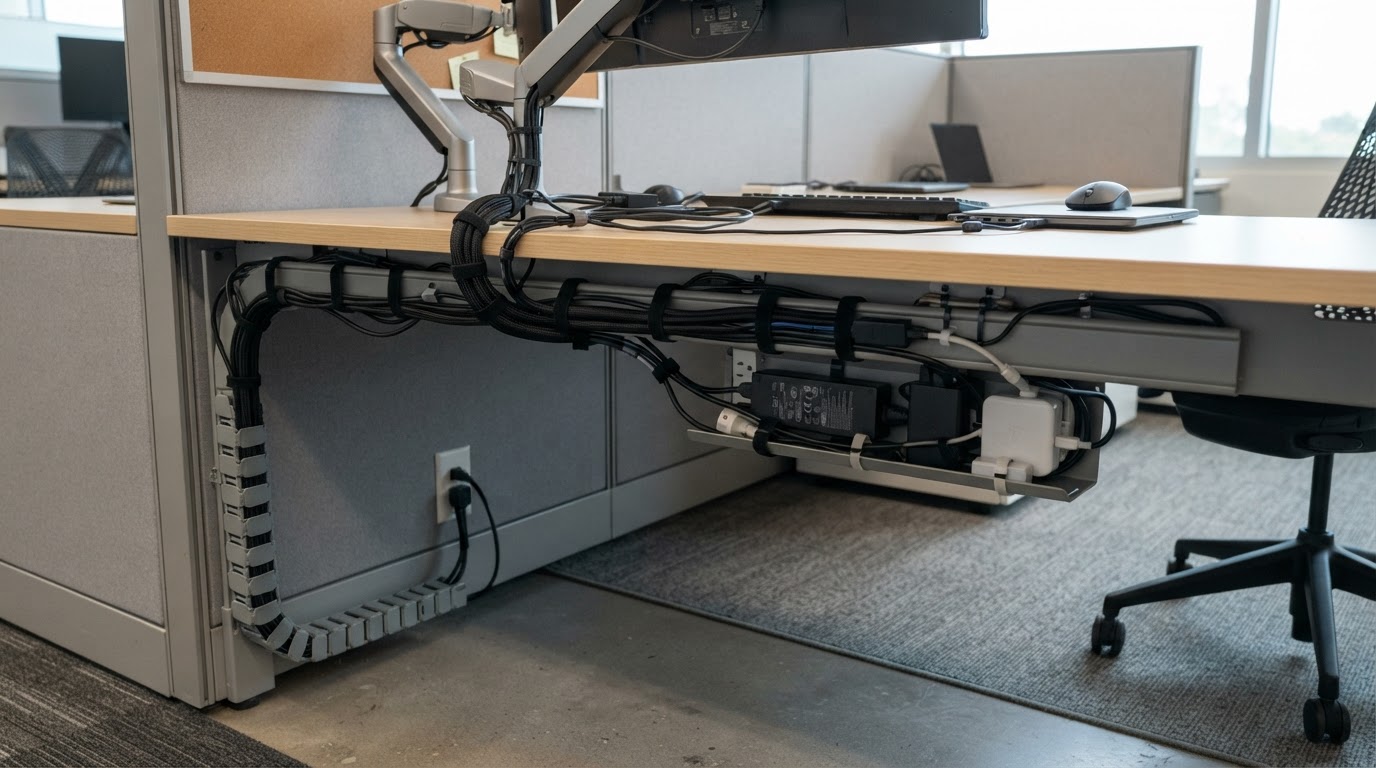

Tangled spaghetti wiring under desks looks unprofessional and presents severe tripping hazards. More importantly, badly managed cabling is a code violation: NEC Article 605 governs workplace wiring, and most jurisdictions enforce it on the furniture inspection that follows a tenant fit-out.
Power and Data Separation
Power and data cables must be physically separated to prevent electromagnetic interference and to meet code. The standard practice is dedicated power channels (the raceway) and dedicated data channels, run in parallel but never in the same conduit. At the workstation, the power whip and the data whip enter the desk through different grommets.
Raceway and Whip Management
The cubicle raceway carries the power from the floor monument to the desk. At reinstallation, the electrician reconnects the whip, tests each outlet, and labels the circuit. A clean raceway is a raceway where every wire has a home and no wire is draped across the inside of the panel.
Cable Loops and Service Loops
Leave a service loop — a small coil of slack — at each connection so the desk can be repositioned without re-pulling cable. A cable pulled tight at installation will fail at the first reconfiguration, because the connector will not release under tension.
Labeling and Documentation
Every cable end is labeled at both ends with the same ID. The floor's cable chart is updated at reinstallation and handed to the IT team at turnover. A labeled, documented cable plant is the difference between a floor IT can service and a floor IT has to re-pull.
Wire management is not the visible part of the move, but it is the part that determines whether the floor is code-compliant and serviceable. Insist on it in the scope and verify it at turnover.
Find Cubicle Relocation & Modular Systems Providers
System panel breakdown, electrical whip disconnects, acoustic fabric wall rebuilds, and reconfiguration.