
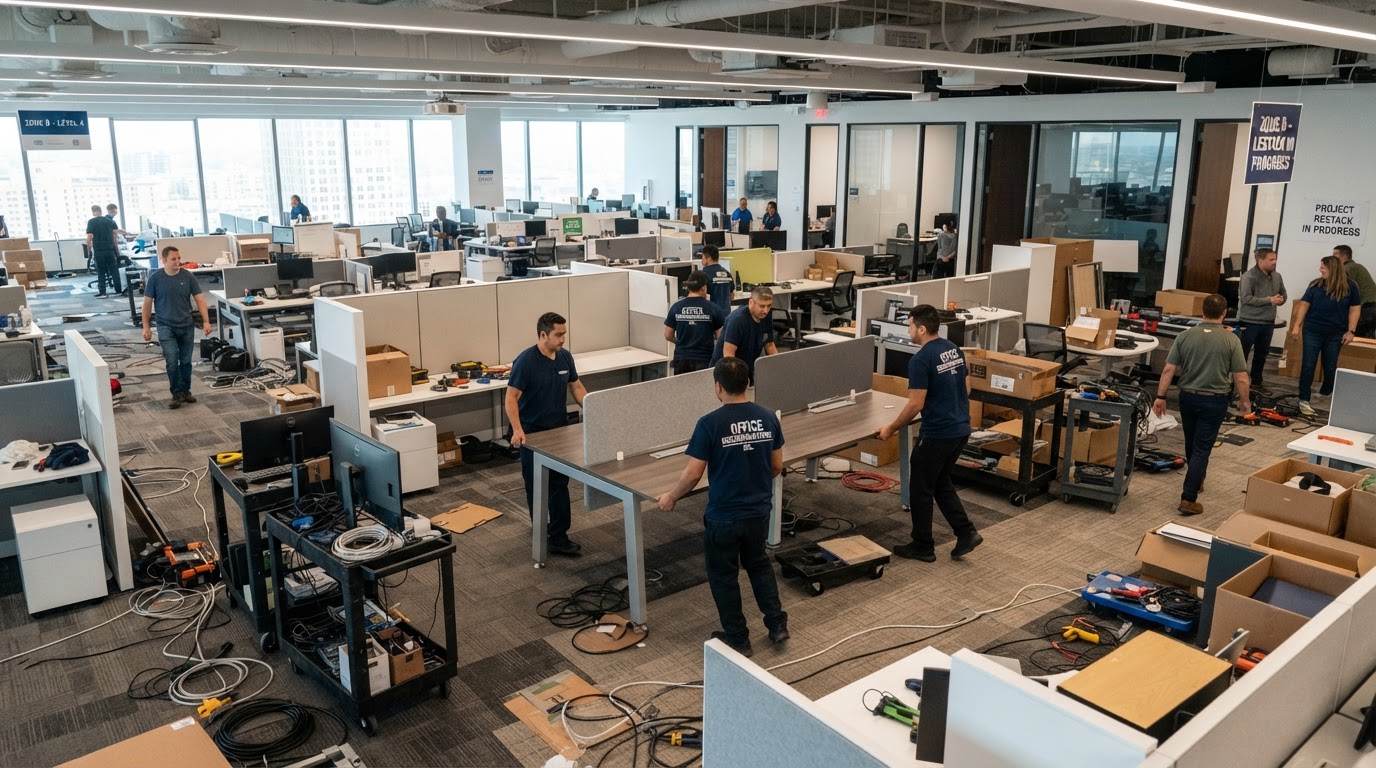

Corporate growth and the rise of hybrid working models have made office "churn" an ongoing reality. Churn is the steady rhythm of departments shifting seats, teams expanding into adjacent floors, and hybrid programs rebalancing desks every quarter. Unlike a full relocation, churn never has a single move day — it has dozens of them.
What Churn Actually Costs
Every internal move — a single desk, a single department — still requires disconnect/reconnect, furniture reconfiguration, cable drops, and cleanup. Unmanaged, churn is the single largest hidden facilities cost on a corporate P&L. Managed well, it becomes a predictable line item the finance team can budget against.
Strategies for Sustainable Churn
- Batch moves: group individual requests into monthly or quarterly waves to keep the mover and IT on a predictable cadence.
- Standard floor templates: pre-approved desk and room configurations let the move crew reconfigure without a custom CAD each time.
- Dedicated move coordinators: a single internal owner prevents conflicting moves and double-booked freight elevators.
- Off-hours execution: internal moves that disrupt neighbors should run after 6 PM or on weekends.
Communication and Minimizing Disruption
Employees tolerate churn when they are told early and often. Publish the monthly move calendar, confirm desk assignments before the move, and give each displaced employee a welcome packet at their new desk. The packet is cheap; the goodwill is not.
Measuring Churn Efficiency
Track cost-per-seat-moved, downtime-per-move, and employee satisfaction with each shuffle. A mature program drives the cost-per-seat down year over year and turns churn from a recurring emergency into a routine facilities service.
Churn is not a problem to be solved once — it is a rhythm to be managed continuously. The companies that do it well treat internal moves as a service, not a series of one-off emergencies.
Find Internal Office Moves & Floor Restructuring Providers
Inter-departmental shuffle, churn moves, floor plan reconfigurations, and hybrid workspace rebalancing.