
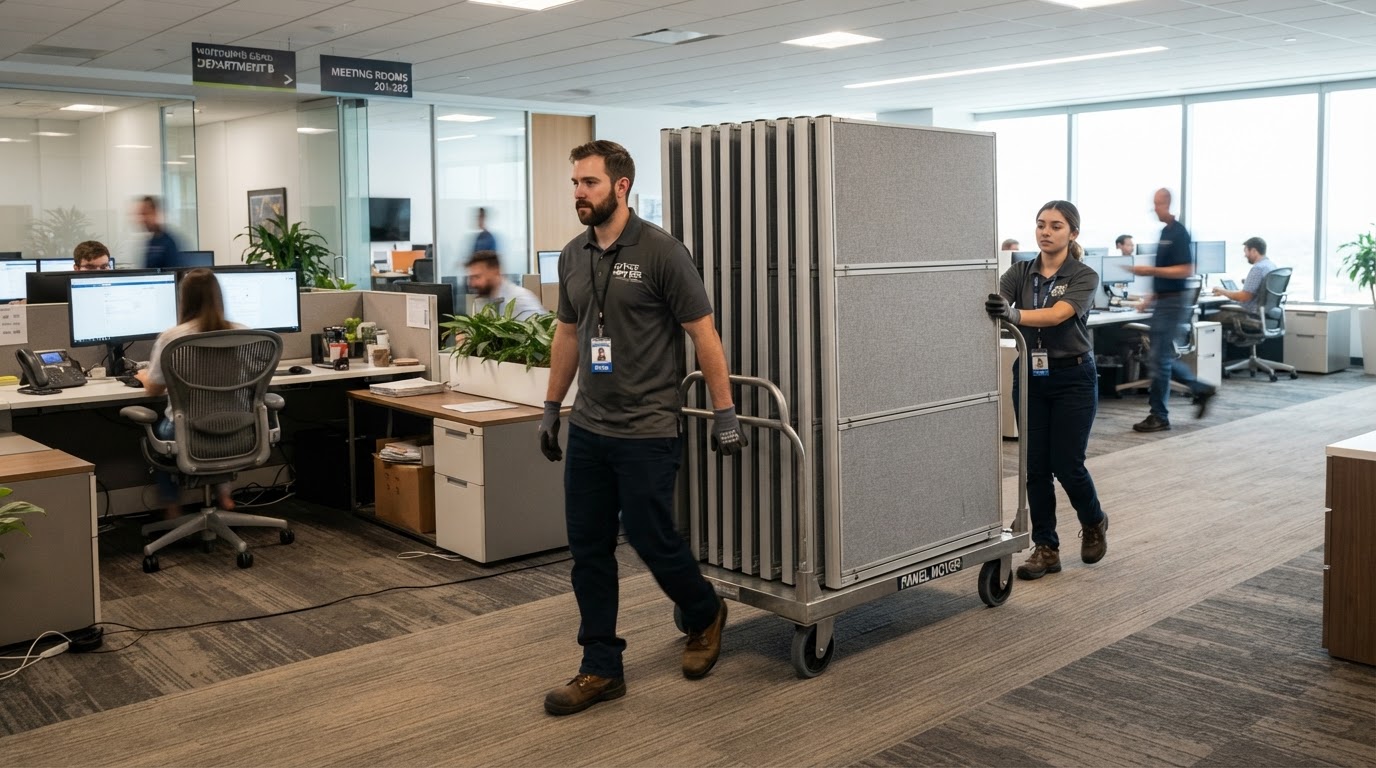

Relocating a floor of modular cubicle systems is a precision trade, not a moving job. Office cubicle movers specialize in the disassembly, transport, and reassembly of modular panel systems — Herman Miller, Steelcase, Teknion, and comparable brands — whose integrated power raceways, connector pins, and cam locks require trained installers, specialized equipment, and a documented protocol. A general moving crew that loads panels onto a truck will arrive at the destination with warped frames, stripped hardware, and a floor that cannot be reassembled to code.
This guide explains what office cubicle movers do differently from general movers and why the specialization matters for your modular furniture investment.
Panel Cart Transport
Modular panels are engineered to travel vertically — not flat. Office cubicle movers use panel carts: rolling racks that hold panels upright during transport. A panel laid flat on a truck bed warps under its own weight and the vibration of the road; a warped frame will not seat correctly at the destination, and the workstation will be out of alignment. The panel cart is the single most important piece of equipment in a cubicle relocation — a crew without one is a crew that will damage the frames.
Raceway and Power Handling
Cubicle power is governed by UL-listed raceway systems — typically 4-wire or 8-wire — that carry power from the floor monument to each workstation. Office cubicle movers staff qualified low-voltage technicians who kill the circuit at the panel, test dead, and disconnect the whip at the monument. The raceway is never cut — cutting the whip means re-terminating the connection at the destination, a service call that costs more than the disassembly if it was done correctly. At the destination, the same technician reconnects the whip, tests each outlet, and labels the circuit.
Hardware Bagging and Labeling
Every screw, cam lock, and connector pin is bagged in a labeled zip bag and taped to the panel it belongs to. The bag label carries the workstation ID and the panel position within that workstation. This is the most critical step in the disassembly: a missing cam lock on workstation 42 becomes a loose panel that wobbles every time the desk is touched. Office cubicle movers treat hardware as part of the panel; general labor treats it as an afterthought.
Reassembly Against the Chalk Line
At the destination, the crew snaps a chalk line from the CAD floor plan and sets the first panel against it. Each subsequent panel is leveled with a torpedo before its connector is torqued. The panels are squared to the line in assembly order — the same order, reversed, in which they were disassembled. The result is a floor of cubicles that sits flush against the wall, plumb to the floor, and wired to code.
Acoustic and Demountable Wall Systems
Modern offices often include modular acoustic walls and demountable glass partitions alongside the cubicle systems. These are engineered assemblies that require the same precision: acoustic fabric panels must be removed in reverse-installation order and re-stretched on the same tension setting, and glass panes must be labeled to their frame positions because the hardware is specific to each opening. Reinstalling a pane in the wrong opening will force the hardware and crack the glass at the first temperature swing.
Manufacturer Recommissioning
Some modular systems — particularly high-density mobile filing and powered workstations with manufacturer warranties — should be recommissioned by a factory-authorized technician after reinstallation. The recommission includes track leveling verification, drive motor testing, and safety sensor calibration. Skipping it may void the warranty and, more importantly, skips the safety check that prevents the system from failing under load.
Insurance for the Furniture Investment
A floor of modular cubicle systems carries a replacement value well into six figures. Confirm the mover's cargo coverage is adequate for the full replacement value, not the federal released-value minimum of roughly $0.60 per pound. Request a Certificate of Insurance naming your company and both landlords as additional insureds, with general liability of $1M to $5M depending on building class.
Hiring office cubicle movers is about protecting a capital investment, not just moving furniture. The crew that brings panel carts, bags hardware, handles raceways correctly, and reassembles against a chalk line is the crew that returns your modular floor intact — and the crew that skips those steps is the crew whose first shortcut becomes a replacement bill.
Find Cubicle Relocation & Modular Systems Providers
System panel breakdown, electrical whip disconnects, acoustic fabric wall rebuilds, and reconfiguration.